Preclinical Proteomics Services – Protein and Post-translational Modification (PTM) Profiling for Drug Development
Mechanism of action, dose and schedule, early safety signals – answered at protein level, in your own model system.
Pharma and biotech teams use systems-level protein data to confirm mechanism of action at pathway level, optimise dose and schedule, detect toxicity early, benchmark compounds and build multi-protein biomarker signatures before entering the clinic. You receive answers to your study question, not a data matrix.
Sciomics is a German proteomics contract research organisation (CRO) supporting preclinical drug development with antibody microarray–based affinity proteomics. We measure hundreds to more than 1,500 proteins per sample – optionally including post-translational modifications such as phosphorylation and ubiquitination – in cell models, organoids, 3D cultures, mouse, rat, non-human primate and human material. Every study includes statistics, pathway analysis and biological interpretation from the same scientific team that ran it.
How pharma and biotech teams use preclinical proteomics
Each of the following questions is answered with the same platform, so results stay comparable across a programme.
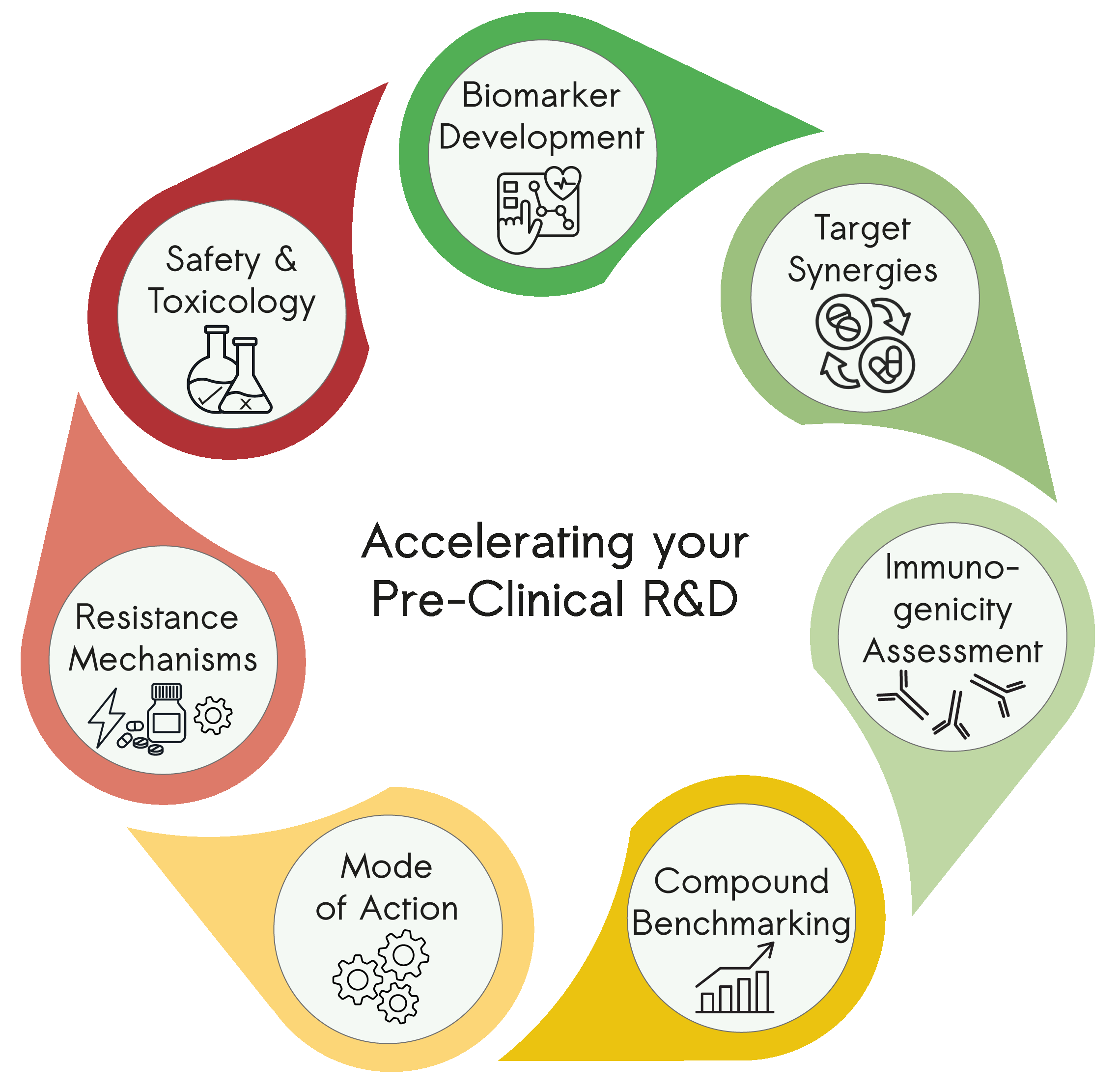
Dose and schedule optimisation
Pathway response curves across dose levels and time points instead of a single endpoint, which shows where the biological effect saturates.
Safety and toxicology
Early protein-level indicators of organ stress, inflammation and cytokine activation, measured in the same samples used for efficacy readouts. Background: modern toxicology and predictive safety assessment. Where a liability only appears through organ interaction or after hepatic bioactivation, we run these studies in human multi-tissue cultures together with FluoSphera SA: translational safety profiling.
Mechanism of action
Pathway-level evidence of target engagement, plus detection of off-pathway effects, including complement activation and cytokine release patterns.
Immunogenicity assessment
Immune and inflammatory protein profiles that separate immunogenic from non-immunogenic responses.
Resistance mechanisms
Identification of compensatory signalling networks that emerge under treatment and drive loss of response.
Target synergies and combination therapy
Molecular interaction patterns of single agents and combinations, used to prioritise combination hypotheses.
Compound benchmarking
Side-by-side profiling of candidates and reference compounds on one comparable data space.
Model assessment
Assessment of how closely a cell model, organoid or animal model reproduces the human protein profile of the indication.
Selected conference posters
- Early toxicity markers – Swiss Biotech Day 2026, with FluoSphera and a global pharmaceutical company. Request the poster (short registration).
- Organoid model characterisation – AD/PD 2022, with a global pharmaceutical company. Request the poster (short registration).
Five challenges in preclinical proteomics – and how Sciomics addresses them
Preclinical proteomics programmes typically stall on five points: limited predictive value of model systems, missing mechanistic context, biomarker signatures that fail to reproduce, fragmented vendor workflows, and no guidance on which proteins to follow.
| Challenge | How Sciomics addresses it |
|---|---|
| Preclinical models with limited predictive value. Model systems often fail to reflect complex human biology, which pushes risk into late-stage development. | Side-by-side protein and PTM profiling of model and human material shows how far a model actually translates. |
| Insufficient systems-level insight. Single-marker approaches rarely capture the dynamic signalling networks that drive disease and drug response. | Hundreds to more than 1,500 targets per sample, mapped onto pathways and networks rather than delivered as a hit list. |
| Biomarkers that fail to reproduce. Low-content methods yield inconsistent results and poor validation success. | Standardised protocols, four technical replicates and an average CV below 10 % produce signatures that survive validation. |
| Fragmented workflows delay decisions. Separate vendors for wet lab, statistics and interpretation slow programmes and add uncertainty. | Study design, assay, statistics and biological interpretation come from one scientific team. |
| No guidance on which biomarkers to pursue. Candidate lists grow faster than the capacity to test them and prioritisation stays subjective. | Broad, unbiased discovery narrows hundreds of candidates to a ranked, testable multi-protein signature. |

Which assay answers which preclinical question
| scioDiscover® | Global, unbiased protein profiling – the broadest view for target and biomarker discovery. |
|---|---|
| scioPhospho® | Phosphorylation-dependent signalling and kinase pathway activity under treatment. |
| scioCyto® | Cytokine and chemokine profiling for immune response and inflammation. |
| scioCD® | Immune cell surface markers and secreted cytokines in one assay, for immunophenotyping without separate panels. |
| scioUbi | Ubiquitination and protein turnover – relevant for degrader programmes and proteostasis. |
Preclinical proteomics at Sciomics – key facts
| Service | Proteomics CRO services for preclinical research and biomarker development |
|---|---|
| Technology | Antibody microarray–based affinity proteomics |
| Readouts | Protein abundance, phosphorylation, ubiquitination, cytokines and chemokines, cell surface markers |
| Content per sample | From focused panels up to more than 1,500 proteins in a single sample |
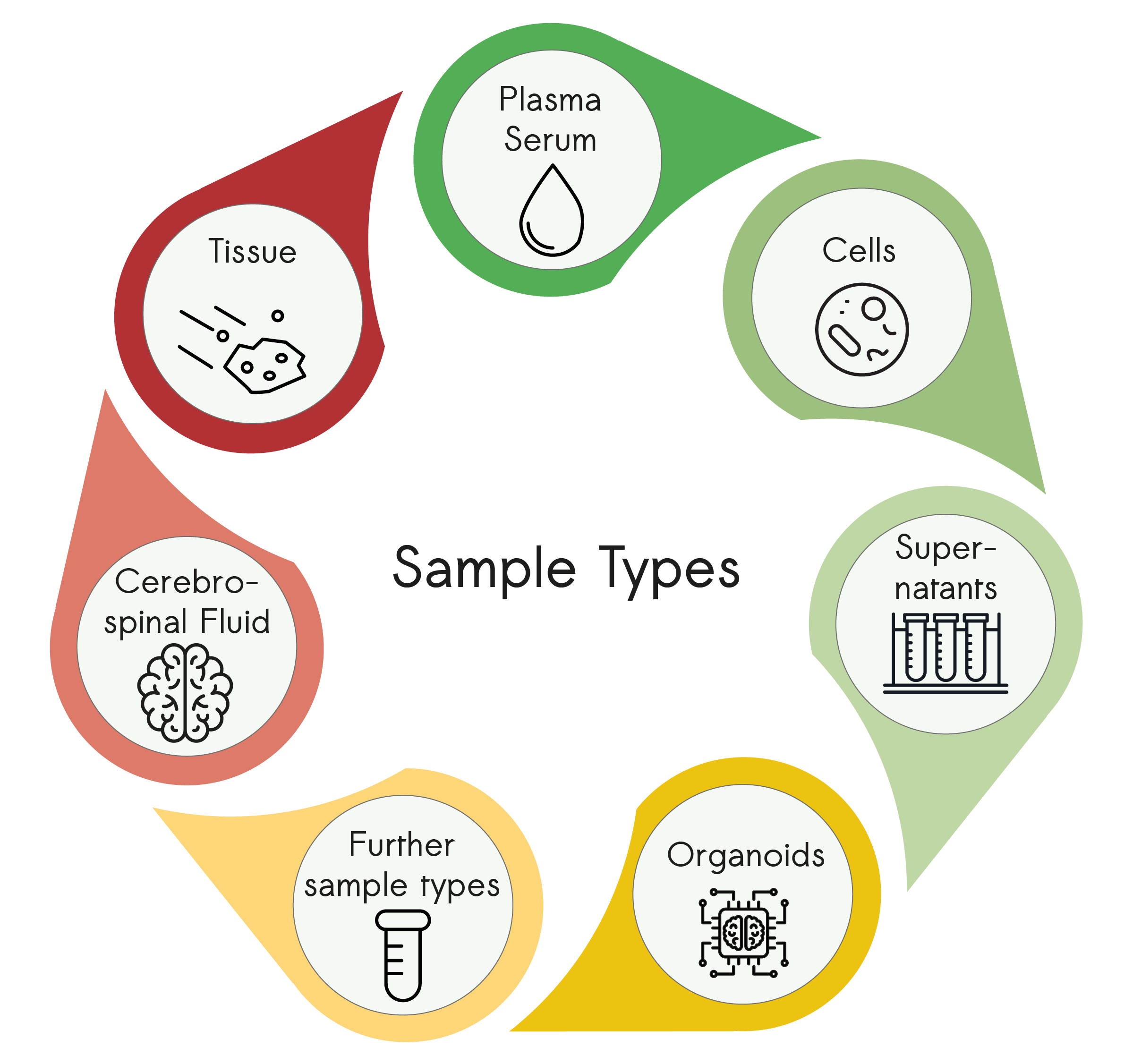
| Sample types | Plasma, serum, CSF, ISF, tissue, cell lysates, culture supernatants, organoids, 3D cultures → Supported sample types and volumes |
| Species | Human, murine, rat, non-human primate and further preclinical models on request |
| Reproducibility | Standardised protocols with four technical replicates per sample, average CV below 10 % |
| Turnaround | Typically three to six weeks from sample receipt to report |
| Deliverable | Publication-ready report with differential expression, pathway and network analysis, plus a joint interpretation session |
Works with the preclinical material you already have
Robust, reproducible protein profiling from minimal input, so precious clinical and preclinical material stays available for other assays. Supported material includes:
- Plasma, serum, urine, interstitual fluid (ISF) and cerebrospinal fluid (CSF)
- Tissue and tissue lysates
- Cell lysates and cell culture supernatants
- Organoids and 3D culture systems
- Human, murine, rat and non-human primate material
Sample types, required volumes and handling instructions
Disease areas we have supported
Sciomics has contributed protein and PTM data to preclinical programmes across the following fields:
- Neurodegenerative diseases (Alzheimer’s disease, Parkinson’s disease, frontotemporal dementia)
- Oncology and tumour microenvironment
- Ageing research
- Cardiovascular diseases
- Skin diseases (atopic dermatitis, psoriasis, ultra-rare skin diseases)
- Inflammatory and autoimmune diseases (inflammatory bowel disease, Crohn’s disease)
- Kidney diseases, including acute kidney injury (AKI)
- Organ damage and organ failure
Programmes in other indications are supported as well – the platform is not restricted to a disease area. Peer-reviewed studies using data from our platform are listed under scientific publications.
Preclinical proteomics – frequently asked questions
What is preclinical proteomics?
Preclinical proteomics is the large-scale analysis of proteins and their post-translational modifications during the research phase before a drug candidate enters clinical trials. It is applied to cell models, organoids, 3D cultures and animal models to confirm mechanism of action, detect toxicity early, judge how well a model reflects human biology and identify biomarker candidates for later clinical studies. Both affinity-based methods such as antibody microarrays and mass spectrometry are used; the choice depends on sample amount, required sensitivity and how comparable the data must be across a study.
What proteomics services does Sciomics provide for preclinical studies?
Sciomics provides antibody microarray–based affinity proteomics as a full CRO service: study design, sample processing, multiplex protein and PTM profiling, statistics, pathway analysis and biological interpretation. Studies cover mechanism of action, dose optimisation, safety and toxicology, immunogenicity, resistance, compound benchmarking, model assessment and biomarker development.
Which sample types and species can be analysed?
Plasma, serum, urine, interstitual fluid, cerebrospinal fluid, tissue, cell lysates, cell culture supernatants, organoids and 3D cultures are supported. Material from human, murine, rat and non-human primate models can be analysed; further preclinical models are possible on request.
How much sample material is required?
Microlitre-scale volumes are sufficient for most liquid sample types, which is why limited preclinical and clinical material remains available for additional assays. Exact volumes depend on the assay and sample type and are agreed during study design.
How long does a preclinical proteomics study take?
Typical turnaround is three to six weeks from sample receipt to a publication-ready report, including statistics, pathway analysis and biological interpretation. Larger sample sets and multi-assay designs are scheduled individually.
How does affinity proteomics compare with mass spectrometry in preclinical work?
Antibody microarrays are targeted and highly sensitive for low-abundance regulatory proteins such as cytokines and signalling proteins, require far less material and deliver directly comparable relative quantification across large sample sets - reported as log fold changes with p-values. A transfer to other immunoassays for validation is straightforward. Mass spectrometry is unbiased at the peptide level and identifies proteins without prior antibody selection. In preclinical programmes the two approaches are complementary rather than mutually exclusive.
Can Sciomics assess how well a preclinical model reflects human biology?
Yes. Profiling model material and human material side by side on the same platform shows which pathways are reproduced by the model and which are not. This translatability check is one of the most frequent reasons pharma teams commission preclinical proteomics.
Which assay should be chosen for a mechanism-of-action study?
Global profiling with scioDiscover® is the usual starting point when the affected pathways are not yet known. When a kinase pathway is already suspected, scioPhospho® adds phosphorylation-level resolution; immune-driven mechanisms are addressed with scioCyto® or scioCD®. Assays can be combined within one study, and the choice is agreed during study design.
Discuss your preclinical study with a scientist
Tell us the question your programme has to answer next and which material is available. You will talk to the scientists who would run and interpret the study, not to a sales desk.
Prefer email? Write to info@sciomics.de.
Related pages: scioDiscover® · scioPhospho® · scioCyto® · scioCD® · scioUbi · Sample types