scioDiscover: Protein profiling & biomarker discovery

Proteomics service for pre-clinical research &

Protein biomarker discovery

Robust, comprehensive & fast

Our high-throughput protein profiling service supports researchers in identifying novel protein biomarkers, understanding disease mechanisms, and accelerating pre-clinical drug development.

Using our proprietary antibody microarray platform, we enable the simultaneous quantification of over 1,500 proteins from minimal sample volumes — ideal for biomarker discovery, pathway analysis, and protein profiling studies.

Partner with Sciomics – your specialized proteomics CRO – and take your biomarker discovery and pre-clinical research to the next level.
   

    Biomarker discovery
 in research blog
  
     Speak with
 a scientist
  

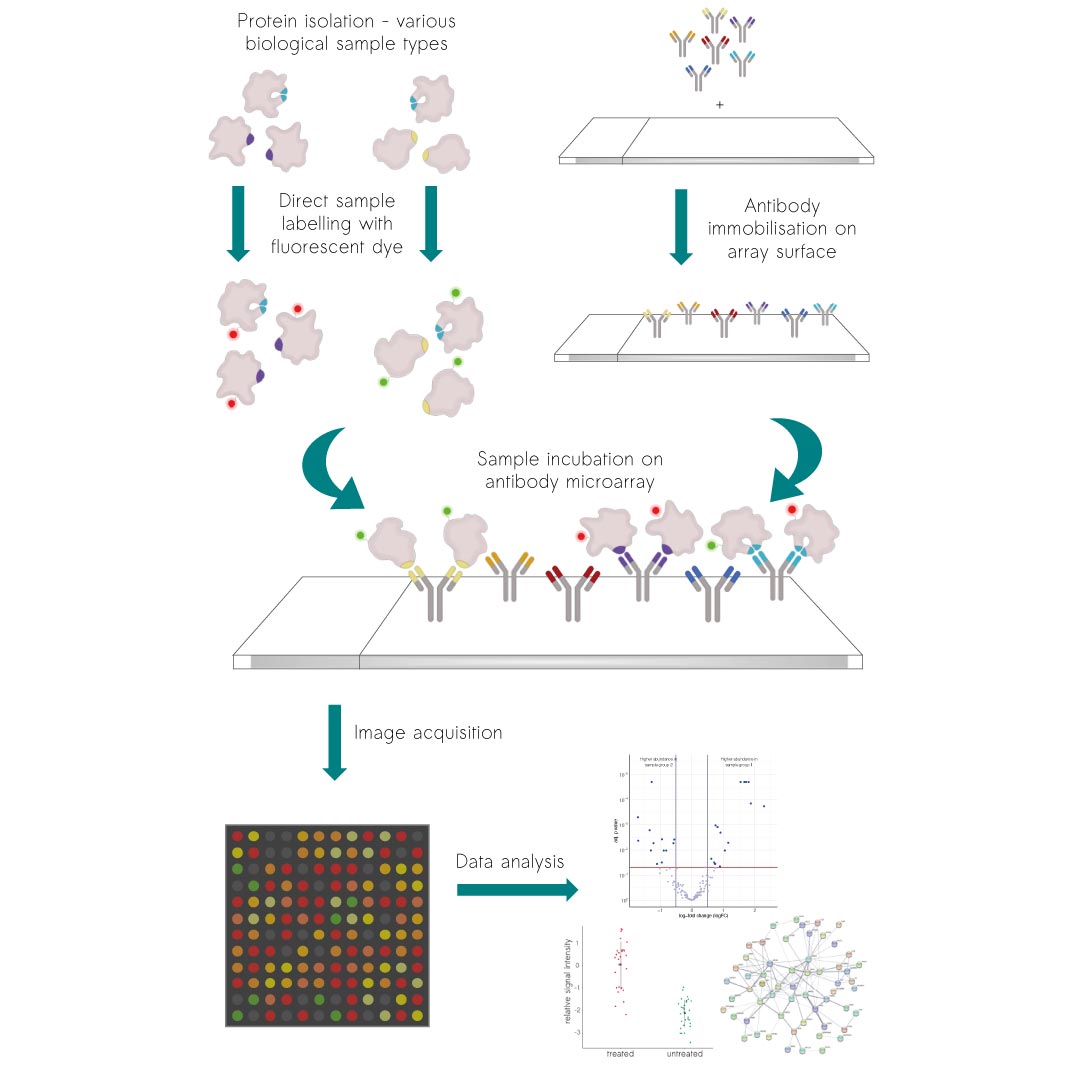
Antibody Microarray Workflow for robust proteomics profiling: Illustration depicting the steps involved in protein profiling using antibody microarrays, from protein isolation and sample labeling to antibody immobilization, sample incubation, image acquisition, and data analysis for the scioDiscover platform.

The Assay

  • High-throughput immuno-based protein profiling using complex antibody microarrays
  • Ideal for pre-clinical protein biomarker discovery and pathway analysis
  • Broad coverage of key biological processes and signaling pathways
  • Native sample matrices (non-fractionated / non-depleted)
  • Highest sensitivity and reproducibility (CV <10%, 4 technical replicates) from minimal sample volumes
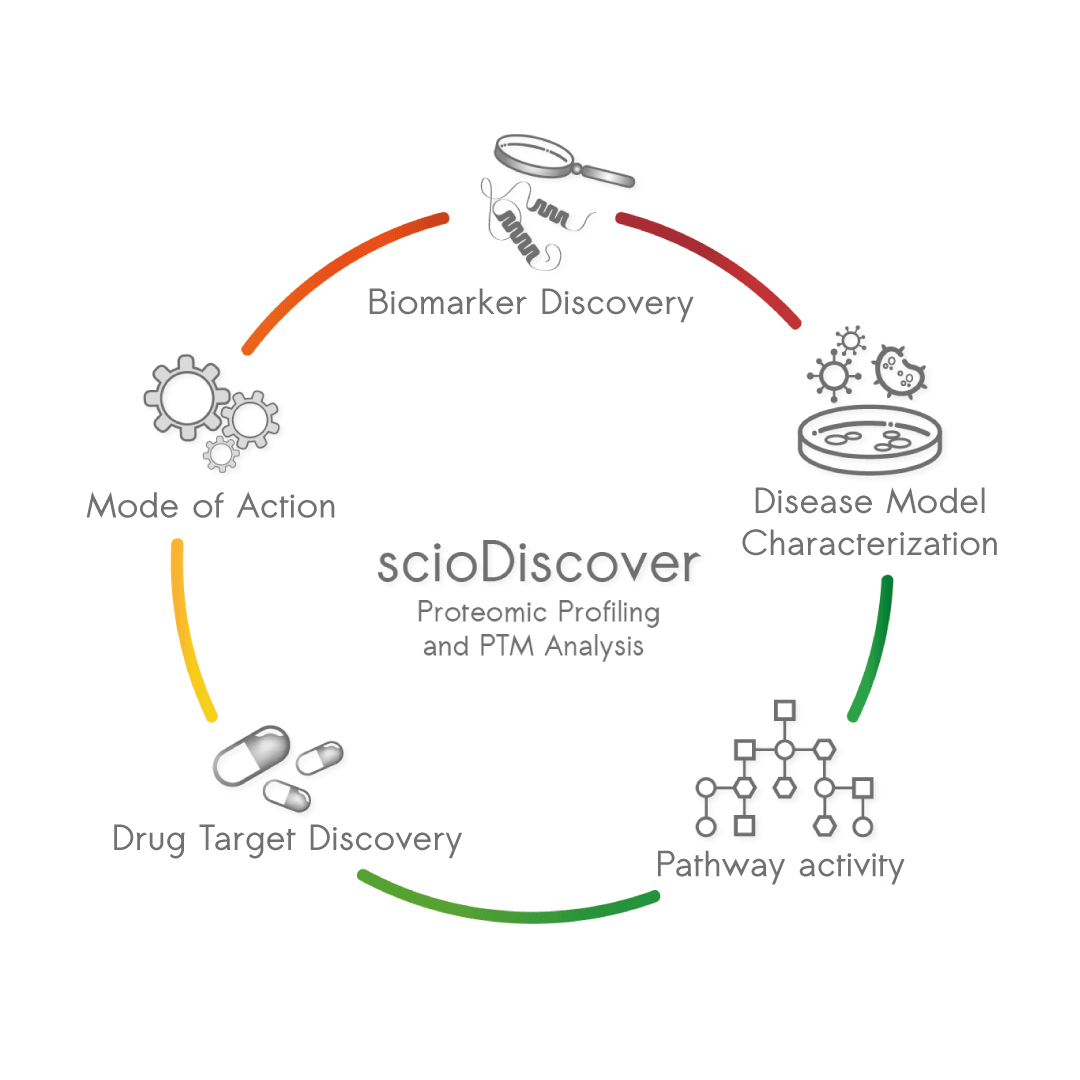
scioDiscover Proteomic Profiling and PTM Analysis: Diagram illustrating the applications of scioDiscover in biomarker discovery, disease model characterization, pathway activity analysis, drug target discovery, and mode of action studies. As your trusted CRO partner for immunobased proteomics, we offer end-to-end support – from study planning and sample analysis to comprehensive data interpretation. Whether you're exploring disease mechanisms or validating drug effects, our platform delivers actionable insights for your research success.


     Speak with
 a scientist


Data Analysis is included

  • In-depth bioinformatic analysis based on > 6,000 data points per sample
  • Protein interaction and pathway network mapping
  • Functional annotation and biological pathway classification
  • Data integration for different sample types

Application examples

  • Protein biomarker discovery
  • Pre-clinical and translational research
  • Pathway profiling and pathway regulation studies
  • Drug response profiling and mode-of-action studies
  • Patient stratification 
  • Basic research 

Compatible sample types

Our service supports a broad range of sample types – even in very limited amounts:

  • Plasma / Serum
  • Cerebrospinal fluid (CSF)
  • Interstitial fluid (ISF)
  • Urine
  • Saliva
  • Tissue lysates
  • Cell lysates / cultured cells
  • Cell culture supernatants
  • Organoids

If you are working with a different type of biological sample, feel free to contact our scientists – we are generally able to analyse any protein-containing sample


Latest Scientific Publications using scioCyto

Article | GPRC5D Loss Promotes Myeloma Resistance to Immunotherapy

| March 2026 | GPRC5D loss promotes immunotherapy resistance and aggressive multiple myeloma growth, supporting early monitoring and dual-targeted treatment strategies. Sciomics supported the study with cytokine profiling of human OPM-2 supernatant samples using the scioCyto affinity proteomics platform.

Munawar et al., Loss of GPRC5D enhances the proliferative capacity and competitive fitness of myeloma upon anti-GPRC5D immunotherapy. Leukemia. Published online March 31, 2026.  

Article | Endothelial Notch1 signaling in white adipose tissue promotes cancer cachexia

| September 2023 | Article: Endothelial Notch1 signaling in white adipose tissue promotes cancer cachexia. Sciomics supported this study by scioCyto serum analysis in a mouse cancer model.

Taylor, J., Uhl, L., Moll, I. et al. Endothelial Notch1 signaling in white adipose tissue promotes cancer cachexia. Nat Cancer 4, 1544–1560 (2023)

Article | HAPLN1 potentiates peritoneal metastasis in pancreatic cancer

| April 2023 | New Article: Wiedmann et al. identified HAPLN1 as a prognostic marker and as a and as a driver for peritoneal metastasis in pancreatic cancer. Sciomics contributed a plasma protein profiling of a mouse model to support this exciting study.

Wiedmann L et al. HAPLN1 potentiates peritoneal metastasis in pancreatic cancer. Nature Communications 14,2354 (2023)

Testimonials

PD Dr. med. Mascha O. Fiedler-Kalenka and Dr. med. Benjamin Seybold

Heidelberg University Hospital, Department of Anesthesiology, Heidelberg, GermanyGerman Center for Lung Research (DZL), Translational Lung Research Center Heidelberg (TLRC), Heidelberg, Germany

"From the very beginning, working with the friendly and highly competent team at Sciomics was both professional and refreshingly straightforward. We particularly valued their openness to our specific research questions and the expert support they provided in planning and interpreting our exploratory cytokine analysis in a preclinical lung injury model. Communication was always on equal footing, enriched by Sciomics’ deep expertise, which also sparked new ideas for future projects."

Product: scioCD

Tara Sigdel, PhD

Associate Professor, Department of Surgery, University of California San Francisco

"We collaborated with Sciomics GmbH in Germany to analyze proteomics data from blood samples of kidney transplant recipients and liver perfusates during normothermic machine perfusion. Throughout the process, Sciomics provided exceptional support, ensuring timely data delivery and valuable assistance with data analysis. Their expertise and commitment have been instrumental in advancing our research, and we are currently using their data in multiple manuscript submissions. I highly recommend Sciomics for their reliable service and expertise in proteomics."

Product: scioDiscover